Part #1
Breadboards provide us a convenient way to make temporary circuits. The surface of the breadboard contains columns and rows of holes. Inside the holes are metal hooks which hold and connect wires, resistors, and any other components in a circuit. The edges of the breadboard are vertical lines of holes: the power and ground line. The power line is used to insert all components you want to connect to power, while the ground line connects components that won’t have power. The middle is made of a series of rows of five which are also connected.
Part #2
Below is a link to a video of my circuit, followed by a picture of my schematic.
https://drive.google.com/open?id=1uPALZ8AgLyHbrNGpEAP39J41uaU-5s9c
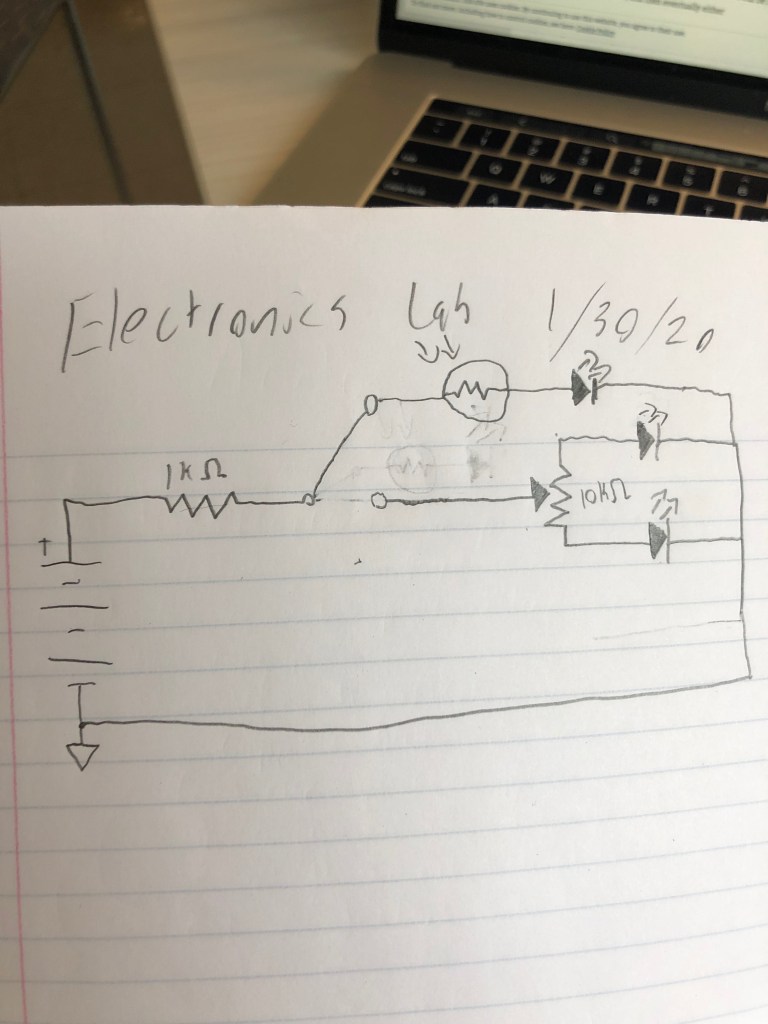
Part #3
Multimeters are used to measure the voltage on power sources like batteries. Since the most common problem in circuits is the power source, multimeters are crucial in ensuring that circuits have sufficient power to work.
Part #4
In the process of putting together my circuit, one of my LEDs burnt out. Although my circuit was routed properly, I made the mistake of keeping the battery plugged in while building. This allowed the LED to most likely overheat because of wires touching while I was building the circuit. Another issue might have been the messiness of my circuit, with too many wires too close to each other.
Part #5
Tia Dizon made a replica of a Boss D-1 Distortion Pedal, using transistor and diode distortion. The pedal contains knobs for gain, low and high pass, and level.
Connor Riley made an effects processor that can be used on anything that can be plugged into it (synths, guitars, phones). The first knob he demonstrates is an overall gain knob. Next, he shows the distortion effect, which contains a knob for dry/wet as well as gain for the dry/wet. He also has high and low pass filters which can be controlled by both light sensors, and knobs. Fourth, he shows the tremolo effect, which has a dry/wet knob, a frequency knob, as well as a triangle/saw wave knob. The processor also contains a volume knob as well as a bypass switch.
Jaye Sosa made a polyphonic synthesizer with a tremolo effect. It has three buttons which each play different thirds of the C major scale.
 Chris's Blog